The Case for Metro Wavelength Division Multiplexing (WDM)
Dense Wavelength Division Multiplexing (DWDM) found rapid acceptance by service providers in long-haul optical transport during the 1990s. The economics in lowering the “cost per bit” were just too compelling.
Coarse Wavelength Division Multiplexing (CWDM) was embraced by enterprise network managers looking to transport high-bandwidth traffic across multi-site campuses in the late 1990s. Again, economics played a big role in this deployment.
So, it seemed natural to develop a business case to introduce WDM into metropolitan optical transport networks as an alternative to legacy SONET systems. Many startups answered the challenge. I’ll look at two.
Dense Wavelength Division Multiplexing (DWDM) found rapid acceptance by service providers in long-haul optical transport during the 1990s. The economics in lowering the “cost per bit” were just too compelling.
Coarse Wavelength Division Multiplexing (CWDM) was embraced by enterprise network managers looking to transport high-bandwidth traffic across multi-site campuses in the late 1990s. Again, economics played a big role in this deployment.
So, it seemed natural to develop a business case to introduce WDM into metropolitan optical transport networks as an alternative to legacy SONET systems. Many startups answered the challenge. I’ll look at two.

WDM in the Metro Struggled for Quite a While
But Metropolitan DWDM struggled to find a foothold as a technology solution to move traffic across urban environments from end users to long-haul networks. The economics in the metro just didn’t pan out. Many promising startups tried to crack this nut, but they failed to do so, at least for a full decade. ONI Systems [1] was one such startup, a feisty service provider supplier incorporated in October 1997.
But Metropolitan DWDM struggled to find a foothold as a technology solution to move traffic across urban environments from end users to long-haul networks. The economics in the metro just didn’t pan out. Many promising startups tried to crack this nut, but they failed to do so, at least for a full decade. ONI Systems [1] was one such startup, a feisty service provider supplier incorporated in October 1997.
Not only did WDM economics NOT fit into the service provider business models for metropolitan deployment, but also the relatively new Metro DWDM solutions came up against Cerent-inspired next generation SONET platforms; the so-called Multi-Service Provisioning Platforms (MSPPs). ONI faced the Cerent onslaught and the excitement Cerent generated over deploying familiar SONET technology in support of voice services, while simultaneously integrating the emerging Ethernet/IP traffic spewing forth from business and residential end users.
Ciena buttressed the ONI approach, by acquiring this technically-savvy startup in 2002, after ONI’s five-year losing battle to survive independently with Metro DWDM offerings [2]. In May 2002, Fiber Optics News reported ONI’s first quarter 2002 results [3], even as the company was being acquired by Ciena, “Sales were $21.0 million and the pro forma net loss of $35.9 million or $0.26 per share. No guidance was provided . . . This compares with net revenues of $45.1 million and a pro forma net loss of $9.3 million or $0.07 per diluted share, in the first quarter of the prior year [2001].”
Ciena believed it could reverse the almost 100 percent decline in ONI’s sales and the almost 400 percent increase in losses from 2001 to 2002 [4]. Many industry analysts, however, felt that Metro DWDM solutions were not preferred in the face of the MSPP option, which could support almost all telco service providers through the telecom meltdown. Fiber Optics News interviewed Merrill Lynch analyst Simon Leopold, who said, “ONI’s results reflect several key points: 1) The metro is not immune to spending cuts; 2) Metro WDM remains a niche application; and 3) Enterprise represents a small but growing application of metro WDM.”
Companies serving metropolitan optical transport networks, such as Cerent-Cisco and Nortel, among others, added DWDM capabilities to their MSPPs. Both OC-48 and OC-192 wavelengths formed the basis for “the development of metro capabilities and intelligent optics,” as Tim Hills reported for Light Reading, in September 2002. He added, “DWDM MSPPs have several key attributes, including: introduction of a managed optical wavelength layer; support for a wide range of existing and emerging client services and technologies; [and] provision of a base for a phased migration to a new network architecture and technology – specifically, all optical.”
Ciena buttressed the ONI approach, by acquiring this technically-savvy startup in 2002, after ONI’s five-year losing battle to survive independently with Metro DWDM offerings [2]. In May 2002, Fiber Optics News reported ONI’s first quarter 2002 results [3], even as the company was being acquired by Ciena, “Sales were $21.0 million and the pro forma net loss of $35.9 million or $0.26 per share. No guidance was provided . . . This compares with net revenues of $45.1 million and a pro forma net loss of $9.3 million or $0.07 per diluted share, in the first quarter of the prior year [2001].”
Ciena believed it could reverse the almost 100 percent decline in ONI’s sales and the almost 400 percent increase in losses from 2001 to 2002 [4]. Many industry analysts, however, felt that Metro DWDM solutions were not preferred in the face of the MSPP option, which could support almost all telco service providers through the telecom meltdown. Fiber Optics News interviewed Merrill Lynch analyst Simon Leopold, who said, “ONI’s results reflect several key points: 1) The metro is not immune to spending cuts; 2) Metro WDM remains a niche application; and 3) Enterprise represents a small but growing application of metro WDM.”
Companies serving metropolitan optical transport networks, such as Cerent-Cisco and Nortel, among others, added DWDM capabilities to their MSPPs. Both OC-48 and OC-192 wavelengths formed the basis for “the development of metro capabilities and intelligent optics,” as Tim Hills reported for Light Reading, in September 2002. He added, “DWDM MSPPs have several key attributes, including: introduction of a managed optical wavelength layer; support for a wide range of existing and emerging client services and technologies; [and] provision of a base for a phased migration to a new network architecture and technology – specifically, all optical.”
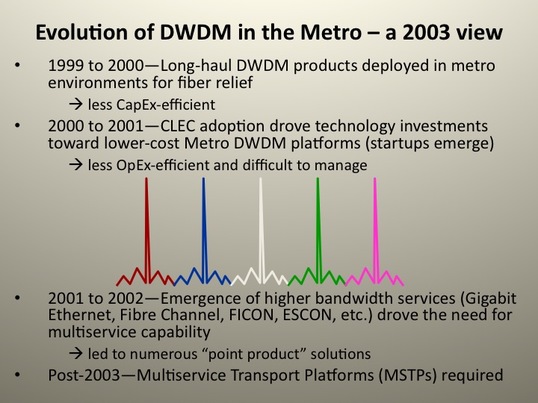
DWDM Evolution in the Metro as presented by Cisco at the 2003 OFC event. The Cisco ONS 15454 would soon evolve around two development streams – one for SONET/SDH applications as an MSPP and another for DWDM applications as an MSTP.
The first eight OC-48 wavelengths offered on Cerent’s ‘454’ MSPP [5] gave the company a North American leadership position in the 2.5 Gbps market, a share even greater than the former juggernaut in optical transport, Nortel Networks, and simultaneously, a solid entry into the Metro DWDM space. Whereas Nortel innovated in the long-haul transport space, Cerent chose to innovate in the metropolitan optical transport space, a space that established vendors, such as Nortel, chose to ignore during the 1990s.
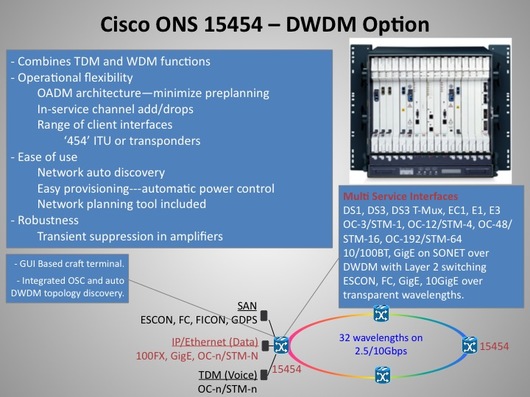
The Cisco ONS 15454 DWDM capability started with eight OC-48 wavelengths and ended up with 32 OC-48 and/or OC-192 wavelengths. Image courtesy Cisco, circa Q2, 2003.
Mark Lutkowitz, CIR’s vice-president of optical networking research, at the time, said to reporter Hills, in the fall of 2002: "It has been the classic chicken-and-the-egg scenario since early 1997, in which the industry has been waiting for a critical mass of wavelengths in the metro space to enable both the optical add/drop multiplexer and optical switching markets to develop. But, until the vendors can provide a combination of lower cost and engineering-friendly DWDM products with true ring capability, the all-optical vision in the metro segment will not begin to be realized.”
It was not primetime for Metro DWDM in the first half of the 2000s. However, the technology would mature and become more cost-effective as ROADMs appeared later that decade. The earlier point-to-point DWDM systems did not satisfy the needs of the service providers, nor were these products certified (standardized) by the large RBOC customers for widespread deployment [6].
Metro DWDM systems remained a niche play well into the mid-2000s, a situation that has changed during the mid-2010s.
[1] Incorporated as Optical Networks, Inc. in October 1997, the company eventually changed its name to ONI Systems Corp., in April 2000, and after filing for an IPO, became a public company on June 1, 2000, despite two lawsuits filed by Nortel Networks against the company and a countersuit filed by ONI. (ONI’s products were so similar to Nortel’s products that ONI was sued for five patent infringements while ONI responded with a suit of its own claiming that Nortel failed to deliver needed optical components.)
[2] Cisco recognized Nortel as the industry leader in the Metro DWDM space, so the company secured a minority stake in ONI in 1999. However, exploratory discussions between Cisco and ONI about being acquired stalled when it was reported in May 2000 that ONI's CEO, Hugh Martin, valued his company at more than the $6.9 billion Cisco paid a year before for Carl Russo’s Cerent. Insiders said that Martin believed he could get a better valuation than Russo. A person’s ego sometimes gets in the way . . . Instead, Cisco felt it could leverage WDM technology from its long-haul DWDM acquisition of Pirelli Optical Systems in December 1999 and its Metro DWDM acquisition of Qeyton Systems in May 2000. The integration of these two additional optical companies and their respective DWDM technologies was assigned to Carl Russo’s Optical Networking Group (ONG) within Cisco. ONG’s main task was to sort out Cisco’s Metro DWDM strategy and develop the right positioning for the company’s growing optical portfolio. In hindsight, ONI’s reticence to deal with Cisco brought ONI, and later Ciena, another formidable competitor.
[3] Fiber Optics News, ONI Systems Sees Revenue Drop in Half, May 6, 2002, p.7.
[4] While Cisco was rounding out its optical portfolio at the outset of the new millennium ONI went public in June 2000. One year later, ONI basked in the post-IPO glow, having secured more than twenty customers and looking to bring another ten customers into the fold. ONI’s market share rapidly grew in the metropolitan market to 25 percent, up from 7 percent the year before, and gaining on market share leader Nortel who garnered 48 percent. Then the dot.com bubble bust and telecom meltdown hit this company hard, as many of its customers went bankrupt or curtailed capital expenditures.
[5] The initial Cerent 454 wavelength plan supported a variety of OC-48 (and planned OC-192) options as follows:
Red Band:
1547.72 nm
1550.92 nm
1552.52 nm
1554.13 nm
Blue band:
1528.77 nm
1529.55 nm
1530.33 nm
1538.19 nm
The OC-48 and OC-192 optics modules for these various wavelengths operated on the 100 GHz ITU grid.
[6] More Metro DWDM equipment found its way into Telcordia’s OSMINE certification process for deployment in American RBOC networks. This was necessary for companies like ONI-Ciena to enter the metropolitan transport space as Operations System Modifications for the Integration of Network Elements (OSMINE) oversees “the interoperability of automated OSS (operations support system) functionality and flow-through provisioning.” Both Cisco and Nortel had an advantage over ONI here. They completed the OSMINE process for their two key products defined as Metro DWDM platforms – Cisco’s ONS 15454 and Nortel’s OPTera 5200 – while Ciena had yet to get through the standardization process with its ONI-based offering. Three Telcordia systems certifications were granted to both Cisco (thank you David Friedman and team) and Nortel:
1. NMA System for network monitoring and surveillance operations support,
2. TIRKS System for provisioning of special service circuits, message trunks, and carrier circuits as well as inventory management of facilities and equipment, and
3. Transport Element Activation Manager in support of multi-vendor transport network-element management, with the objective of eliminating service activation bottlenecks when different products are optically interconnected.
It was not primetime for Metro DWDM in the first half of the 2000s. However, the technology would mature and become more cost-effective as ROADMs appeared later that decade. The earlier point-to-point DWDM systems did not satisfy the needs of the service providers, nor were these products certified (standardized) by the large RBOC customers for widespread deployment [6].
Metro DWDM systems remained a niche play well into the mid-2000s, a situation that has changed during the mid-2010s.
[1] Incorporated as Optical Networks, Inc. in October 1997, the company eventually changed its name to ONI Systems Corp., in April 2000, and after filing for an IPO, became a public company on June 1, 2000, despite two lawsuits filed by Nortel Networks against the company and a countersuit filed by ONI. (ONI’s products were so similar to Nortel’s products that ONI was sued for five patent infringements while ONI responded with a suit of its own claiming that Nortel failed to deliver needed optical components.)
[2] Cisco recognized Nortel as the industry leader in the Metro DWDM space, so the company secured a minority stake in ONI in 1999. However, exploratory discussions between Cisco and ONI about being acquired stalled when it was reported in May 2000 that ONI's CEO, Hugh Martin, valued his company at more than the $6.9 billion Cisco paid a year before for Carl Russo’s Cerent. Insiders said that Martin believed he could get a better valuation than Russo. A person’s ego sometimes gets in the way . . . Instead, Cisco felt it could leverage WDM technology from its long-haul DWDM acquisition of Pirelli Optical Systems in December 1999 and its Metro DWDM acquisition of Qeyton Systems in May 2000. The integration of these two additional optical companies and their respective DWDM technologies was assigned to Carl Russo’s Optical Networking Group (ONG) within Cisco. ONG’s main task was to sort out Cisco’s Metro DWDM strategy and develop the right positioning for the company’s growing optical portfolio. In hindsight, ONI’s reticence to deal with Cisco brought ONI, and later Ciena, another formidable competitor.
[3] Fiber Optics News, ONI Systems Sees Revenue Drop in Half, May 6, 2002, p.7.
[4] While Cisco was rounding out its optical portfolio at the outset of the new millennium ONI went public in June 2000. One year later, ONI basked in the post-IPO glow, having secured more than twenty customers and looking to bring another ten customers into the fold. ONI’s market share rapidly grew in the metropolitan market to 25 percent, up from 7 percent the year before, and gaining on market share leader Nortel who garnered 48 percent. Then the dot.com bubble bust and telecom meltdown hit this company hard, as many of its customers went bankrupt or curtailed capital expenditures.
[5] The initial Cerent 454 wavelength plan supported a variety of OC-48 (and planned OC-192) options as follows:
Red Band:
1547.72 nm
1550.92 nm
1552.52 nm
1554.13 nm
Blue band:
1528.77 nm
1529.55 nm
1530.33 nm
1538.19 nm
The OC-48 and OC-192 optics modules for these various wavelengths operated on the 100 GHz ITU grid.
[6] More Metro DWDM equipment found its way into Telcordia’s OSMINE certification process for deployment in American RBOC networks. This was necessary for companies like ONI-Ciena to enter the metropolitan transport space as Operations System Modifications for the Integration of Network Elements (OSMINE) oversees “the interoperability of automated OSS (operations support system) functionality and flow-through provisioning.” Both Cisco and Nortel had an advantage over ONI here. They completed the OSMINE process for their two key products defined as Metro DWDM platforms – Cisco’s ONS 15454 and Nortel’s OPTera 5200 – while Ciena had yet to get through the standardization process with its ONI-based offering. Three Telcordia systems certifications were granted to both Cisco (thank you David Friedman and team) and Nortel:
1. NMA System for network monitoring and surveillance operations support,
2. TIRKS System for provisioning of special service circuits, message trunks, and carrier circuits as well as inventory management of facilities and equipment, and
3. Transport Element Activation Manager in support of multi-vendor transport network-element management, with the objective of eliminating service activation bottlenecks when different products are optically interconnected.
 RSS Feed
